- Published on
How to pick the best outdoor wooden bench for your space
- Authors

- Name
- Outdoor Wooden Bench
Most people shop for an outdoor bench the way they shop for art. They scroll until one looks right, then try to justify it.
That works until the bench arrives, warps in your climate, and does not fit the space you measured badly.
Reverse the order and the decision gets easy. Five questions, asked in this sequence, do almost all of the work.
Where will it sit? How many people, how often? How much maintenance will you do?
What is it for? What is the real budget, including upkeep?
Answer those five before you open a single listing, and the shortlist builds itself.
Everything else is a detail you check afterward, on two or three candidates. Wood species, slat thickness, joinery, hardware. It is not a filter to apply to a hundred.
1. Where will it sit?
Not “in the garden”. Specifically which spot, and what happens to that spot.
Covered porch or veranda. Rain is not the enemy; UV and dryness are. Almost any wood works, and even pressure-treated pine becomes reasonable.
Open garden, exposed. Full weather. This is teak territory, or cedar and acacia if you commit to an annual oil.
Poolside or sprinkler line. Constant splashing. You want dense, oily wood and stainless hardware, because ordinary hardware will rust-streak within a season.
Balcony, small space. Weight and footprint dominate. Look at backless or storage benches.
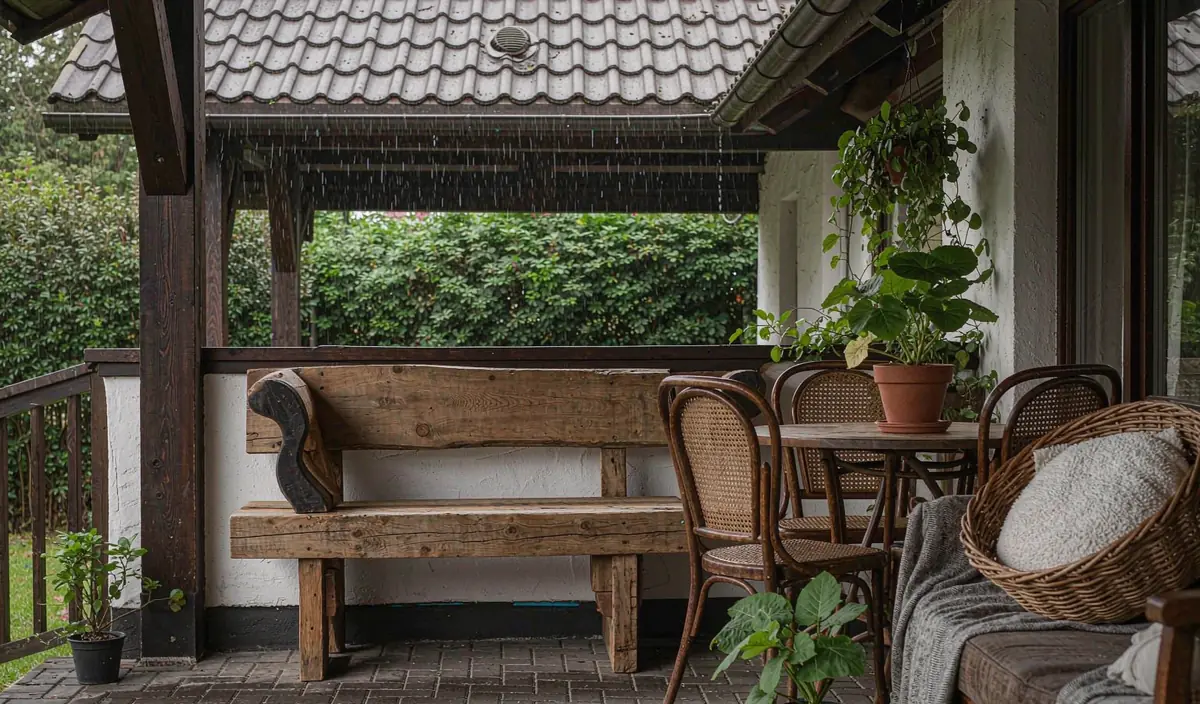
Be specific about the spot. A bench ten feet further from the house can have a completely different moisture profile.
Four things happen to a bench for outside, and the spot you choose decides how much of each it gets.
Water. Rain, sprinkler overspray, pool splash and dew. Water sitting on end grain starts rot. Water cycling in and out of a joint loosens it.
Sun. Ultraviolet light bleaches and dries the surface, which is why an unsealed bench goes gray. On a covered porch, this is the main force acting on the wood.
Freeze and thaw. Water that got into a crack expands overnight and pries it wider each winter. This is why fall sealing matters more than spring painting.
Salt and chlorine. Near the coast or beside a pool, both attack metal faster than they attack wood. Rust streaks are permanent.
Run a five-minute audit of the spot before anything else. How many hours of direct sun does it get in summer? Where does water land and drain?
What is the wind like? A freestanding bench on an exposed balcony is a different problem from one tucked into a corner.
Who walks past it, and how much room do they need?
That last point is where a few inches ruin a good placement. Leave 24 to 30 inches between the front edge of the seat and anything you sit opposite. A coffee table or a fire pit counts.
Keep main walking routes at 36 inches. A backed bench needs a few inches behind it for the rake of the backrest. Push it hard against a wall, and you waste part of its own comfort.
Placement comes first because it rules woods in and out before you fall for a photo. A soft, low-resistance species would disappoint in an open garden. On a covered porch, it is a perfectly sound choice.
That difference can save you several hundred dollars.
If you have not chosen a wood yet, the five species compared covers exactly what each one survives.
Once you settle the spot, there is a guide for each one. The patio bench guide, the garden bench guide, the patio storage bench guide, the small wooden bench guide and the park bench for the public-seat look.
2. How many people, how often?
Bench width is where wishful thinking does the most damage. The workable rule is about 24 inches of seat width per person. It applies to adults, not children.
4-foot bench. Two adults, snugly.
5-foot bench. Two adults comfortably.
6-foot bench. Three adults.

If the bench is for two people who like each other, a 4-footer is fine. If it is for guests, go 5 or 6 feet.
Seat depth matters too. Eighteen to 20 inches is comfortable for sitting upright. Deeper than that, and people slouch or perch.
Both numbers come from one place. The dimensions guide lays out all four in one chart, for six bench types.
Two warnings about the numbers on a listing.
First, a bench described as “two-person” or even “three-person” is quoting the overall length. That includes the arms and any decorative end panels.
Measure the seat between the arms, not the outside of the frame.
Second, frequency of use changes the spec more than the headcount does. A bench for a daily half-hour of reading needs a raking back and honest seat depth. A bench two people sit on four times a summer can be backless and simple.
If comfort matters, these are the figures worth checking.
Seat height: 16 to 18 inches. Lower feels like a garden perch, higher leaves feet dangling for shorter sitters.
Seat depth: 18 to 20 inches. Much deeper, and people perch on the front edge to keep their backs on the seat.
Backrest rake: 5 to 15 degrees past vertical. A dead-vertical back looks tidy and feels stiff after ten minutes.
Armrests: 8 to 9 inches above the seat, 2 to 3 inches wide. Arms are the most commonly missed feature by people who meant to read on the bench.
Weight capacity: roughly 250 to 350 pounds per seated person for solid wood with sound joinery. Folding benches are the exception, since their limit is usually the hinge rather than the wood.
One more arithmetic check before you buy. Measure the space twice, once as an empty gap and once with whatever lives beside it. A recess, a doorway swing or a pair of planters can each remove more room than the bench gains.
3. How much maintenance will you do?
This is the question people lie to themselves about, and it decides satisfaction.
| Your honest answer | Wood to look at |
|---|---|
| None, ever | Teak, or any bench kept under cover |
| One afternoon a year | Cedar or acacia, oiled |
| I like tinkering | Eucalyptus, or treated pine with a sealer |
A teak bench costs more upfront and less over ten years. It wins if the alternative is a bench you meant to oil and did not.
In every wood type there is a spread between the good listings and the disappointing ones. The details below are what separate them.
It helps to pick a finish philosophy rather than a product. The four options ask for different amounts of your time.
Let it weather. Cedar, teak and eucalyptus go silver-gray and stay sound if you keep them clean. This is a legitimate choice, not neglect.
That gray is just surface fiber that has oxidized, and the structure underneath is fine.
Oil once a year. Cedar, acacia and eucalyptus take one or two thin coats after a wash. Oil feeds color in, never flakes, and takes an afternoon including drying time.
Seal it. A film-forming sealer holds color and water out for longer, then eventually peels. When it does, the fix is sanding back to bare wood. Choose sealer only if you will own that cycle.
Paint it. Paint suits softwoods such as treated pine, and hides grain and filler alike. It needs scraping and a fresh coat every few years. It also traps moisture if you apply it over damp wood.
Whatever you choose, the routine that keeps a bench alive is small. Wash it twice a year with warm water, a squirt of dish soap and a soft brush. Go with the grain.
Check every bolt with a driver while you are out there, and look hard at the feet. Feet standing on soil or damp pavers wick water up through the legs.
Set the bench on rubber pads or a couple of pavers. That adds years for almost no effort.
The honest test is not whether you like the idea of oiling a bench. It is whether you would spend a Sunday afternoon doing it when the weather is finally nice.
If the answer is no, buy the bench that survives without you. Teak, or any bench on a covered porch, or a treated pine bench you re-seal every second year.
One boundary worth accepting up front. Maintenance extends life. It does not resurrect wood.
If a screwdriver probe finds soft spots at the leg joints, no oil will bring the bench back.
The care guide takes the routine further: mold, gray wood, winter covers and when to give up.
4. What is it for?
A bench you sit on to read for an hour needs a back and probably a cushion. A bench you perch on to pull off boots does not.
Reading, coffee, conversation. Backrest, arms if you can get them, cushion.
Entryway or mudroom boot bench. Backless, hard-wearing, possibly with storage.
Dining bench at a table. Backless, so it tucks under. Eighteen inches high to match a standard table.
Garden feature. Appearance leads. Make sure the wood still suits the exposure.
Purpose decides the shape of the bench, and there are only a few shapes to choose between. A backed bench is for lounging. A backless bench is for perching, tucking under tables, and staying out of the way.
Arms help anyone getting up, and hurt anyone trying to lie down.
Storage changes the calculation again. A bench with a lifting lid has to keep its contents dry as well as hold its own weight. If that is the plan, it is worth understanding how a storage bench goes together before you buy.
It is also worth admitting that some benches are furniture and some are scenery. A bench at the end of a path is doing a decorating job. Two pots and a watering can on it make that clear.
Just do not buy scenery and expect it to be comfortable for an hour with a book. If both jobs matter, buy for comfort and let the plants find somewhere else.
Finally, count how many benches you need. Two small benches in different places usually beat one large bench in the wrong place. A backless bench by the door, plus a backed bench under the tree, costs less than one compromise in between.
5. What is your real budget, including upkeep?
Sticker price is not the cost. Add the maintenance over the years you expect to own it.
Take a $250 acacia bench. It needs $15 of oil and two hours a year. That is not a $250 bench.
Over eight years it is closer to $400 plus a weekend a year. That can still be the right answer, since acacia looks excellent for the money. Just make the comparison honestly against a $900 teak bench that needs nothing but an occasional wash.
In practice, the market sorts into three tiers. The tier you choose should follow from the answers above, not from the sale price.
| Tier | Price | What you get |
|---|---|---|
| Entry | $100-250 | Treated pine or budget acacia; sealer every one to two years |
| Mid | $200-450 | Cedar, eucalyptus or better acacia; one oil a year |
| Buy once | $600-1,500+ | Teak; nothing but a wash, and a second person to move it |
Working out the five-year total makes the tiers less lopsided than they look. Add the oil and the hours, and the $250 acacia bench lands near $325 over five years.
A $300 cedar bench lands near $375 and five hours. A $900 teak bench stays at $900 and almost no hours. It is only getting started at the five-year mark.
Spending more buys longevity in exactly four places. Denser and more naturally resistant wood, thicker slats, better joinery, and better hardware.
Spending more buys nothing in three others. Carved decoration, a brand name, and bundled cushions.
If two benches cost the same, look at the build. One with a thicker seat slat, a pegged frame and stainless hardware wins. Ignore what the product photography suggests.
Three specs worth checking on any listing
Whatever you end up buying, these three details predict longevity better than brand or price.
Slat thickness and span. Seat slats around 1 inch or more. Thinner slats flex, and flexing is what cracks them.
Span matters as much as thickness. On a seat wider than four feet, look for a center rail or an extra bearer underneath. If the listing shows an underside photo, count the supports before you count the features.
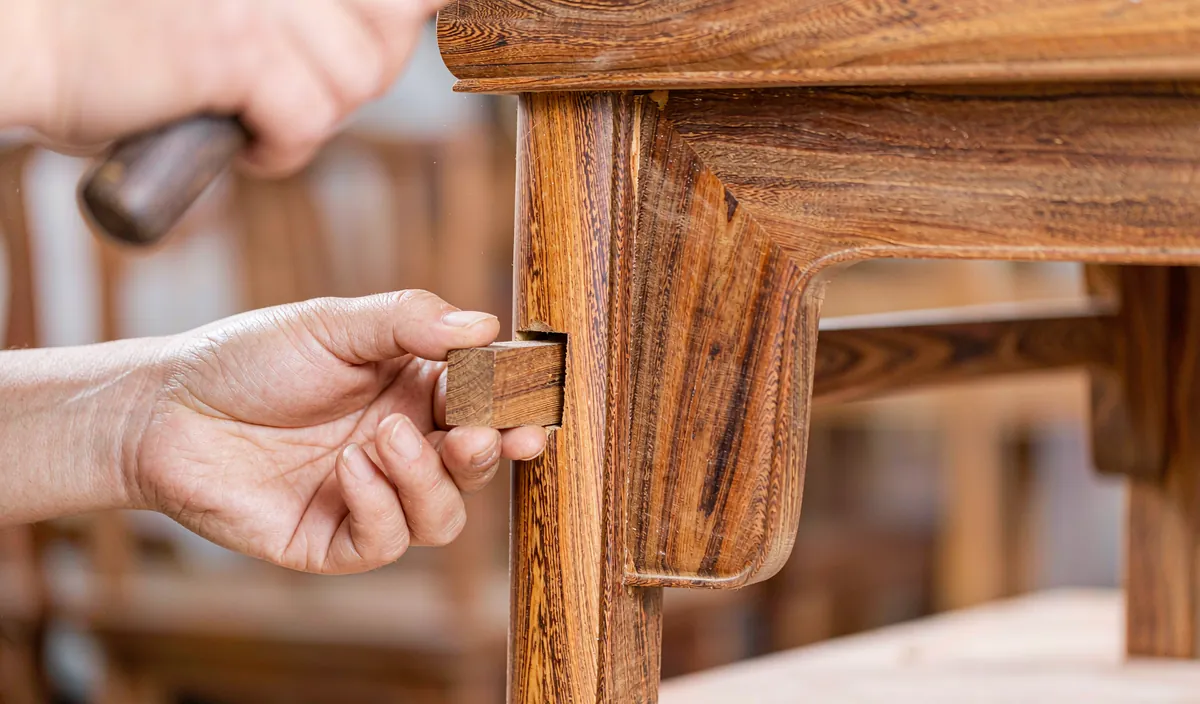
Joinery. Mortise-and-tenon, doweled or bolted frames outlast screwed-through-end-grain frames in every species. End grain drinks water like a bundle of straws. Screws driven into it work loose within a few seasons.
Zoom in on the joint photos. Look for pegs, dowels or through-bolts rather than screws vanishing into the end of a rail.
The build guide shows that end-grain joint done properly, with a pilot hole and two screws rather than one.
Hardware. Stainless or galvanized hardware. Rust streaks running down light wood are permanent, and no oil will lift them. The iron reacts with the wood’s own tannins and stains the grain itself.
Zinc-plated hardware belongs on indoor furniture. Near a pool or the coast, look for 316-grade stainless, often sold as marine grade.
Two claims are worth ignoring.
“Premium hardwood” without a species name usually means the seller does not want to tell you what it is. The species is the single biggest factor in how the bench behaves outdoors.
“Teak-finish” or “teak-look” describes a color, not a wood. A bench that names its species is a bench whose maker expects you to check.
There is one more detail that never appears in marketing copy and probably should. Sealed end grain.
The cut ends of seat slats, rails and feet should arrive looking slightly darker or film-coated.
If they look pale and raw, seal them yourself. It takes an hour with a brush and a tin of end-grain sealer. That is one of the cheapest things you can do for the life of the bench.
Questions that come up every time
How big a bench do I need for two adults?
A 5-foot bench is the honest answer, and 6 feet if you want two people to sit without touching.
Shops sell four-foot benches as two-seaters, and they are, for two people who are comfortable being close. Remove the width taken by arms and end panels before you decide.
Should I buy a bench with arms?
Buy arms if anyone using the bench is older, pregnant, or recovering from anything that makes standing up awkward. Arms turn a bench from something you sit on into something you can get out of.
Skip arms if you want to lie down. Skip them too if the space is so tight that arms cost you usable seat.
Is it worth buying a bench I have to oil?
Yes, if you will oil it, and no if you will not. Cedar and acacia at $150 to $400 are excellent value for a damp climate or a covered patio. The price assumes one afternoon a year with a rag.
If that afternoon will never happen, either buy teak or buy treated pine and accept a shorter life.
What is the cheapest bench that still lasts?
Pressure-treated pine, kept under cover, re-sealed every year or two. It has almost no natural resistance, so the chemicals do the work and the sealer keeps the chemicals in.
Expect five to ten years from a well-kept one, against twenty or more from teak in the same spot.
The short version
Decide the spot, then the size, then the wood, then the style.
If you want to skip ahead, the best picks page sorts the market by use case. That is the fastest route to the best outdoor bench for your space.
Teak for low maintenance, cedar for damp climates, acacia for budget hardwood. Each category comes with the specs that decide whether a bench lasts five years or twenty-five.
If you are still choosing between species, the five types compared lines them up on cost and care.
And if you have narrowed the search to one listing, take the three specs above with you. Slat thickness, joinery and hardware.
They are dull to check, and they decide almost everything.